
Self-Supervised and Topological Signal-Quality Assessment for Any PPG Device
Published in 2025 IEEE 21st International Conference on Body Sensor Networks (BSN), 2025
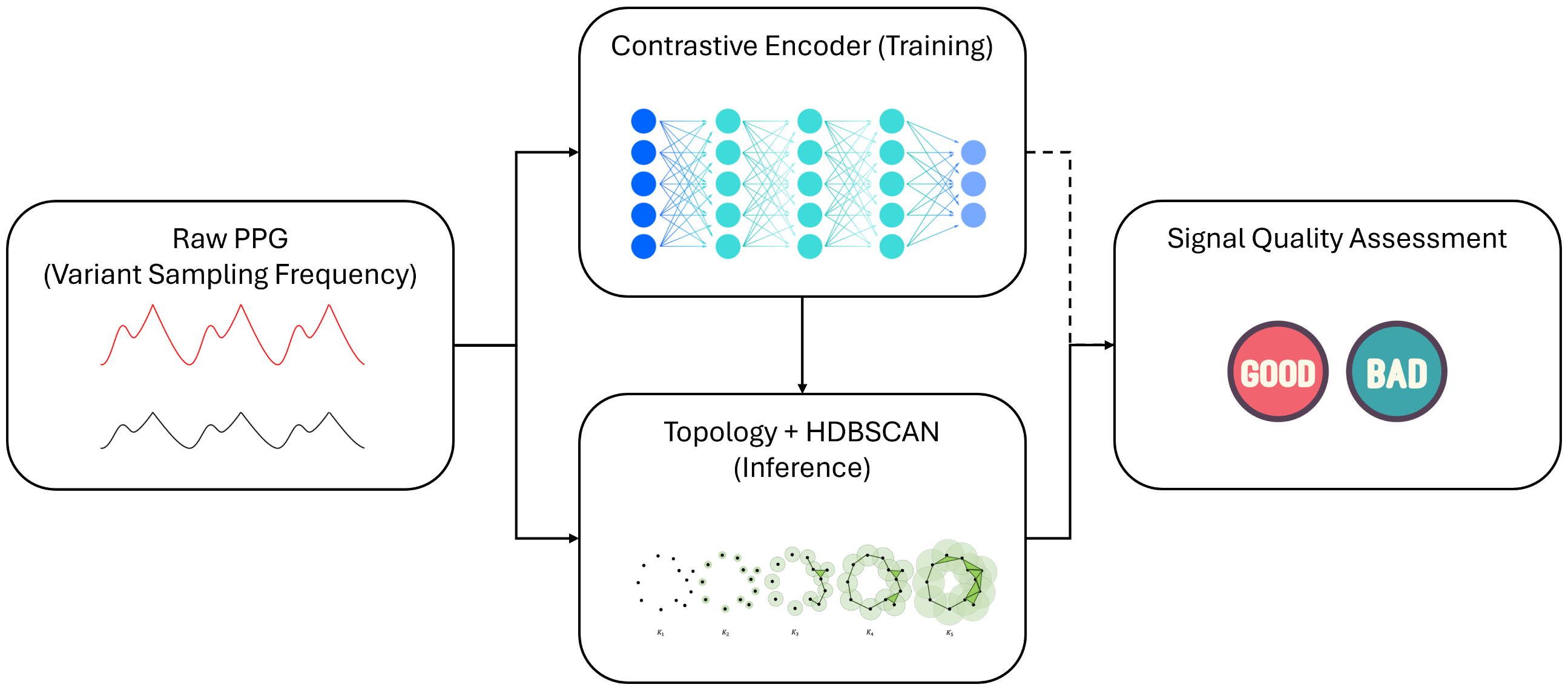
Wearable photoplethysmography (PPG) is embedded in billions of devices, yet its optical waveform is easily corrupted by motion, perfusion loss, and ambient light—jeopardizing downstream cardiometric analytics. Existing signal-quality assessment (SQA) methods rely either on brittle heuristics or on data-hungry supervised models. We introduce the first fully unsupervised SQA pipeline for wrist PPG. Stage 1 trains a contrastive 1-D ResNet-18 on 276 h of raw, unlabeled data from heterogeneous sources (varying in device and sampling frequency), yielding optical-emitter- and motioninvariant embeddings (i.e., the learned representation is stable across differences in LED wavelength, drive intensity, and device optics, as well as wrist motion). Stage 2 converts each 512-D encoder embedding into a 4-D topological signature via persistent homology (PH) and clusters these signatures with HDBSCAN. To produce a binary signal-quality index (SQI), the acceptable PPG signals are represented by the densest cluster while the remaining clusters are assumed to mainly contain poor-quality PPG signals. Without re-tuning, the SQI attains Silhouette, Davies-Bouldin, and Calinski-Harabasz scores of 0.72,0.34, and 6,173, respectively, on a stratified sample of 10,000 windows. In this study, we propose a hybrid self-supervised-learning-topological-dataanalysis (SSL-TDA) framework that offers a drop-in, scalable, cross-device quality gate for PPG signals.